



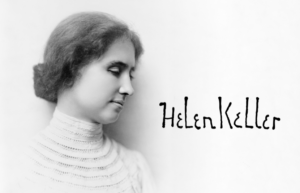
You already know Helen Keller was both blind and deaf.
So the big question in your mind is clear:
How did Helen Keller write a book at all?
Did she really write them herself?
And how many books did Helen Keller write in her lifetime?
Let’s walk through it step by step, in simple language, short paragraphs, and a friendly tone.
Quick Answer: Did Helen Keller Really Write a Book?
Yes.
Not just one.
Helen Keller wrote at least 14 books and hundreds of essays and speeches.
Her most famous Helen Keller book is:
- “The Story of My Life” (1903) – her autobiography, written when she was still in college.
So if you were wondering, “did Helen Keller write a book?”
The answer is: Yes. Many. And she worked very hard for each one.
First, Who Was Helen Keller?
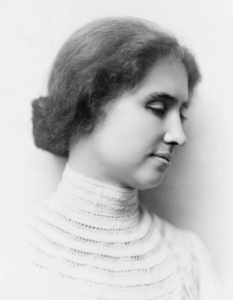
Very quickly, just to set the scene.
- Helen Keller was born in 1880 in Alabama, USA.
- At 19 months old, she lost her sight and hearing after an illness (likely scarlet fever or meningitis).
- For years, she couldn’t communicate in any clear way.
- At age 7, teacher Anne Sullivan arrived, and changed everything.
From there, Helen went on to:
- Learn language
- Go to college (Radcliffe College, Harvard’s women’s college)
- Become a writer, activist, and public speaker
Now let’s get into the real question:
How did a deafblind woman actually write books?
How Did Helen Keller Learn to Communicate?
To understand how Helen Keller wrote a book, you first need to know how she communicated at all.
1. Finger Spelling into Her Hand
Anne Sullivan used a method called the manual alphabet.
She would:
- Take Helen’s hand
- Spell words using finger positions
- Press those shapes into Helen’s palm
For example:
- Anne would run water over Helen’s hand
- At the same time, she would spell “W-A-T-E-R” into Helen’s palm
- One day, it finally clicked, Helen understood “this cool stuff = the word water.”
That was the turning point.
From there, language opened up.
2. Braille: Reading with Her Fingers
Helen also learned Braille, the system of raised dots you feel with your fingers.
Through Braille, she could:
- Read books
- Study for college
- Take notes for her writing
3. Speaking and Lip-Reading by Touch
Helen even learned to speak out loud (though her speech was not always easy for everyone to understand).
She also learned to:
- Put her fingers lightly on a person’s lips, cheek, and throat
- Feel the vibrations and movements
- “Lip-read” by touch
All of this together gave her the tools she needed to think, learn, and later, write.
Step-by-Step: How Did Helen Keller Actually Write a Book?
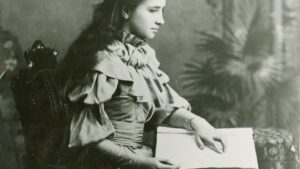
Now let’s get very practical.
Here’s how Helen Keller wrote a book, in real life, with the tools she had.
1. Ideas and Planning (Through Conversation)
First, she needed ideas, just like any writer.
She would:
- “Talk” with her teacher or companion (Anne Sullivan, later Polly Thomson)
- They used finger spelling in her hand
- They discussed memories, stories, arguments, and themes
In this stage, she:
- Choose which stories to tell
- Decided what message she wanted to share
- Planned the structure of chapters and sections
So the thinking work?
Very much hers.
2. Drafting: Dictating with Her Hands or Voice
When it was time to actually draft pages, she had a few methods.
Method A: Dictation by Hand
- Helen would finger spell her words into her helper’s hand
- The helper (secretary, teacher, or friend) would write or type them out in regular print
- This was often how long texts, like chapters, were first created
Method B: Dictation by Voice
Later in life, after she learned to speak:
- She would speak her words aloud
- A secretary would type or handwrite what she said
Either way, the sentences, ideas, and style were hers.
The physical writing was assisted because she couldn’t see the page.
3. Writing Herself: Braille & Typewriter
Helen didn’t depend only on dictation.
She also used:
Braille Slate and Stylus
- A slate (a metal guide) and stylus (a sharp tool)
- She punched Braille dots into heavy paper from right to left
- When flipped, the page was readable Braille
She used this for:
- Notes
- Drafts
- Personal writing
Braille Typewriter & Regular Typewriter
She also used:
- A Braille typewriter (like an early Perkins Brailler)
- A standard typewriter, by memorizing the keys like a touch typist
On a normal typewriter, she:
- Felt for starting points
- Typed by memory, not by sight
- Of course, made mistakes, which helpers later corrected
So yes, she physically typed as well as dictated.
4. Editing: Back-and-Forth with Helpers
Just like any writer, Helen needed editing.
The process usually went like this:
- She produced a draft (by dictation or typing).
- A helper would read it back to her by:
- Finger spelling into her hand, or
- Using Braille copies
- Helen would:
- Change words
- Rearrange sentences
- Add or remove sections
- The editor or publisher would:
- Suggest changes
- Correct spelling and punctuation
- Prepare the final print version
So when you hold a Helen Keller book, you’re holding:
- Her thoughts and words,
- Shaped with help from teachers, secretaries, and editors.
How Many Books Did Helen Keller Write?
You asked this directly, so let’s answer clearly.
Most historical sources say Helen Keller wrote:
Around 14 books
plus hundreds of articles, essays, and speeches.
The exact count can vary a little, depending on how people count revised editions and collections, but 14 is the usual number you’ll see.
Famous Helen Keller Books (Key Titles)
Here are some of her most important books, with simple notes so you know what’s what:
- The Story of My Life (1903)
- Her first autobiography
- Covers her childhood, meeting Anne Sullivan, learning language
- Still the most famous Helen Keller book
- Optimism: An Essay (1903)
- Short work on hope, courage, and positive thinking
- The World I Live In (1908)
- Describes how she experiences the world without sight or hearing
- Very useful if you wonder: “How did Helen Keller navigate her world?”
- Out of the Dark (1913)
- Essays and speeches about social issues and workers’ rights
- My Religion (1927)
- Explains her spiritual beliefs
- Later republished as “Light in My Darkness”
- Midstream: My Later Life (1929)
- Second volume of autobiography
- Covers her adult life, travels, and activism
- Peace at Eventide (1932)
- A collection of essays and reflections
- Helen Keller’s Journal, 1936–1937 (1938)
- Personal journal entries from her mid-life
- Let Us Have Faith (1940)
- Essays about faith, courage, and hope
- Teacher: Anne Sullivan Macy (1886-1904)
- A biography of her teacher Anne Sullivan
- A very personal, loving tribute
These are not all of them, but they give you a good map of her writing.
Was It “Really” Her Writing If She Had Help?
You might still be thinking:
“If someone else typed or wrote the words, did Helen Keller really write a book?”
Fair question.
Let’s look at it honestly.
- Yes, Helen depended on others for:
- Physical writing
- Reading back drafts
- Spelling, grammar, and publication details
- But the core content, the:
- Stories
- Observations
- Opinions
- Feelings
- Style of expression
— came from Helen Keller herself.
Today, we might compare it to:
- A person with limited mobility dictating to a speech-to-text app
- An author working with a ghostwriter or editor to polish their ideas
The process is shared.
The voice is hers.
A Small Controversy: The “Frost King” Incident
To be transparent (this builds trust), there was an early controversy.
As a child, Helen wrote a story called “The Frost King.”
Later, people noticed it was very similar to another story, “The Frost Fairies” by Margaret Canby.
Most historians believe:
- Helen probably heard the story long before
- Forgot where it came from
- Recreated it from memory, thinking it was her own
This experience shocked her and made her:
- Extra careful about originality later in life
- Very sensitive to the idea of copying
It’s an important reminder that she was a human writer, not a myth.
She struggled, learned, and improved, like any author.
What Can You Learn from Helen Keller as a Writer?
Let’s bring this back to you for a moment.
Here’s what Helen Keller’s writing process can teach you:
- Your limitations don’t define your voice.
She was deafblind, and still a powerful author. - Collaboration is normal, not cheating.
Editors, helpers, and assistants are part of most serious writing. - Tools don’t matter as much as ideas.
She used Braille, touch, and typewriters.
You might use a phone, laptop, or AI, the important part is your message. - Drafting and editing take time.
Helen’s books came from many rounds of revising.
Your first draft doesn’t have to be perfect either.
FAQ: Short Answers to Your Main Questions
1. How did Helen Keller write a book if she was blind and deaf?
- She planned ideas by “talking” through finger spelling with her teacher or companion.
- She dictated her words by hand or by voice to a secretary who wrote or typed them.
- She used Braille and typewriters to write and take notes herself.
- Then she edited by having drafts read back into her hand and making changes.
2. Did Helen Keller write a book on her own?
She wrote with help, but the thoughts and stories were her own.
She needed:
- People to handle ink on paper
- Editors to help prepare work for publishers
But the content, ideas, and life experiences are Helen Keller’s.
3. How many books did Helen Keller write?
She wrote around 14 books and hundreds of essays and speeches.
4. Which Helen Keller book should I read first?
If you’re just starting, begin with:
- “The Story of My Life” – for her childhood and famous breakthrough
- Then “The World I Live In” – to understand how she experienced reality through touch, smell, and imagination
5. Did Helen Keller really write a book?
Yes. Helen Keller really wrote books.
She did get help with the physical part (typing, formatting, publishing), but the ideas, stories, and message came from her.
6. How did Helen Keller communicate?
Helen Keller mainly communicated through finger spelling into her hand (the manual alphabet).
She also used Braille for reading and writing, and later learned speech and lip-reading by touch (feeling vibrations on a person’s face and throat).
Want to Explore More About Helen Keller?
If you’d like to go deeper (and also build trust with solid sources), here are some helpful external links:
- American Foundation for the Blind – Helen Keller Biography
A detailed, authoritative overview of her life and work:
https://www.afb.org/about-afb/history/helen-keller - The New Yorker – “What Helen Keller Saw”
A long-form article exploring how she perceived the world:
https://www.newyorker.com/magazine/2003/06/16/what-helen-keller-saw
These will give you more depth, context, and historical detail.
Last updated: January 28/2026